Tax Alert
12 May 2023Clarifications on the guidelines on the registration of IT-BPM RBEs with the BOI
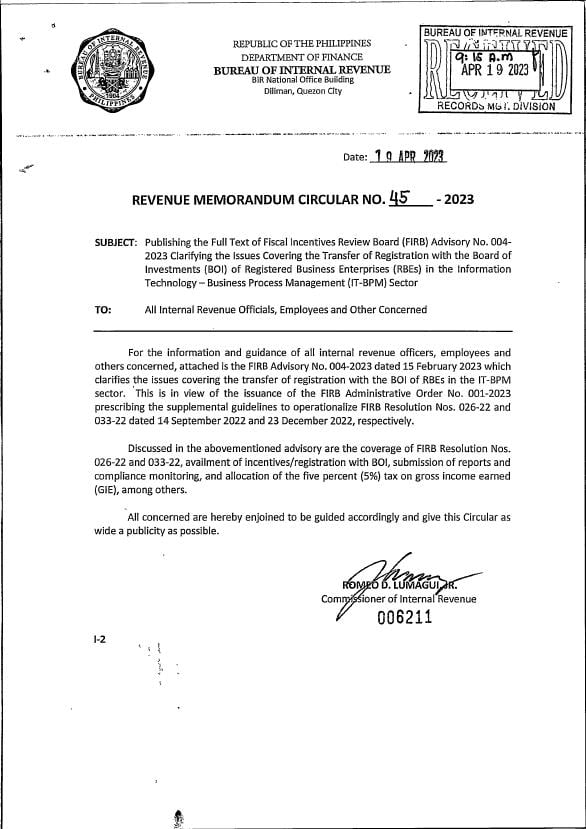
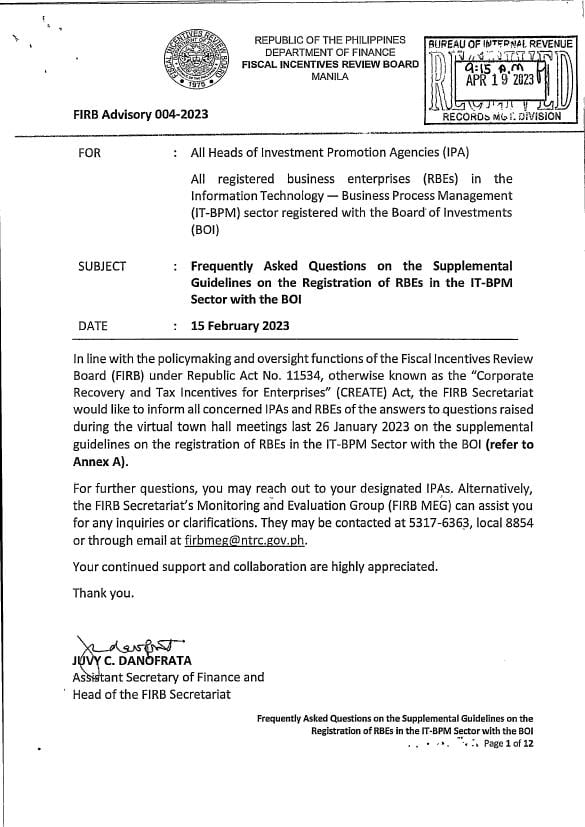
(FIRB Advisory 004-2023 dated February 15, 2023 and Revenue Memorandum Circular No. 45-2023, issued on April 19, 2023)
This Tax Alert is issued to inform all concerned on the clarifications on the supplemental guidelines on the registration of Information Technology and Business Process Management (IT-BPM) Registered Business Enterprises (RBEs) with the Board of Investments (BOI).
Coverage of FIRB Resolution Nos. 26-2022 and 33-2022
- Only IT-BPM projects registered with other Investment Promotion Agencies (IPAs) on or before September 14, 2022 shall be allowed to register with the BOI under Fiscal Incentives Review Board (FIRB) Resolutions No. 26-2022 and 33-2022. All registration of new or expansion projects from September 15, 2022 onwards shall be with the BOI if the enterprises wishes to avail of the 100% WFH arrangement.
- IT-BPM RBEs who failed to register with the BOI by January 31, 2023 but still implemented WFH arrangements in 2023 shall be subject to a penalty on the regular corporate income tax (RCIT) as specified in FIRB Advisory No. 003- 2023, and Bureau of Internal Revenue (BIR) Revenue Memorandum Circular Nos. 23-2022, 39-2022, and 120-2022. This is without prejudice to the suspension or withdrawal of tax incentives or cancellation of the corresponding Certificate of Registration (COR), upon further assessment by the concerned IPAs or the FIRB.
- Any penalty in case of non-compliance with the WFH conditions, shall be computed based on 100% or the entirety of the RCIT for the month/s of non-compliance and not merely on the percentage of non-compliance.
- The BOI-COR cannot be amended after January 31, 2023 to include expansions or new projects to allow these new projects or expansions to implement WFH arrangements. Separate registration with the BOI should be applied for new or expansion projects or activities of IT-BPM to avail of WFH arrangements.
Availment of Incentives/Registration with BOI
- IT-BPM RBEs must submit the newly issued BOI-COR to the original or concerned IPA for the annotation of the original COR issued by the said concerned IPA. For the Philippine Economic Zone Authority (PEZA)-registered IT-BPM RBEs, the BOI-COR shall be submitted to the PEZA’s Office of the Board Secretary (OBS).
- The BOI-issued official receipt shall be accepted as proof of BOI registration in lieu of the BOI-COR if the latter has not yet been issued. The BIR and Bureau of Customs (BOC) shall accept the official receipt as proof that the BOI-COR will be secured by IT-BPM RBEs.
- The date indicated in the BOI-issued official receipt shall serve as the effective date of registration with the BOI. IT-BPM RBEs may already implement 100% WFH arrangement from such date.
- The registration with the BOI is not a “transfer” of registration but an additional registration on top of the IT-BPM RBE’s existing registration with other IPAs. The registration with BOI shall be the basis for fiscal incentives, while the registration with the original IPA shall be the basis for non-fiscal incentives and the corresponding terms and conditions of registration. Hence, IT-BPM RBEs must continue to follow the regulations implemented by both IPAs to maintain their fiscal and non-fiscal incentives.
- When filing tax returns with the BIR, the IPA name that will be indicated in the return to easily identify those under dual registration shall use the syntax “Concerned IPA-BOI”.
- Hence, if the concerned or original IPA is PEZA, the IPA field in the tax return shall be filled-out as “PEZA-BOI”.
Submission of Reports and Compliance Monitoring
- Requests for the Certificate of Authority to Import (CAI), Certificate of Entitlement to Tax Incentives (CETI), and VAT Zero- rating certificate shall still be applied with the original IPA even if the RBE is already BOI-registered. The existing process for applications shall apply but IT-BPM RBEs are advised to coordinate with their original IPA for any additional reportorial requirements or procedures.
- If the VAT zero-rating certificate for 2023 has already been obtained from PEZA, IT-BPM RBEs are required to request an amended VAT zero-rating certificate indicating the required annotation specified in FIRB AO No. 1-2023.
- Compliance with the procedural rules and reportorial requirements of the original IPA shall still be observed by IT-BPM RBEs after registration with the BOI, unless otherwise declared by the original IPA.
Allocation of the five percent (5%) tax on gross income earned (GIE)
- Provided that the IT-BPM RBE does not change its registered address or registered location, there shall be no change on where the corresponding share of LGU shall be remitted. Further, employees under a WFH arrangement shall not be assessed by the LGU as provided under Department of Finance Local Finance Circular No. 001-2022.
Movement of capital equipment and other assets within and outside the economic zones and/or freeport zones
- The Tax Exemption Indorsement (TEI) issued by the Department of Finance - Revenue Office (DOF-RO) as proof of VAT and/or customs duty exemption of imported goods is different from the Certificate of Registration and Tax Exemption (CRTE) issued by the IPA as proof of the registration of the RBE and the available fiscal incentives. However, pursuant to the CREATE act, the Certificate of Entitlement to Tax Incentives (CETI) shall now serve as the proof of entitlement to income tax incentives.
- All IT-BPM RBEs registered with the BOI are required to secure a TEI, regardless of the date of registration.
- The one-time blanket TEI shall apply to all imported goods as of January 31, 2023 that availed of import VAT and/or duty exemption and are still in the books of accounts of the registered project/activity. The TEI applies to all imported goods, irrespective of the asset's current location, and whether the asset is permanently situated in the economic or freeport zone or will be transferred subsequently.
- If an IT-BPM RBE has multiple projects, blanket TEIs shall be secured on a per-project basis. The term “project” means those supported by a separate COR or Supplemental Agreement (SA), as applicable.
- The TEI serves as proof of VAT and/or duty exemption of importations and does not cover local purchase of goods. Locally purchased goods qualified for VAT zero-rating shall be supported by the VAT zero-rating certificate issued by the IPAs.
- In case of an IT-BPM RBE with multiple projects but only one project is responsible for the importation of equipment for delivery to the other projects, the use of one project to consolidate all importations that will be eventually used by other separately registered projects is contrary to the objective of requiring separate books of accounts per project. Hence, the tagging of imported assets must follow the tagging per separate books of accounts. The related assets must be traced back to the project to which it was booked and where the related depreciation or expense is reported.
- Imported assets that will not be supported by a TEI will be subject to the corresponding duties and taxes determined by the BOC.
- The registration for the TEI system is done online but the TEI for existing goods and new shipments shall be filed personally at the DOF-RO. IT-BPM RBEs outside Metro Manila may engage brokers to secure the TEI if the company issues an authorization letter granting the broker the authority to apply for a TEI on behalf of the Company.
- The 30-day deadline for submission of reports prescribed by AO No. 1-2023 shall be counted from the date of issuance of the BOI-COR and not on the date of the BOI-issued official receipt. Nevertheless, the covered period of the reports shall retroact to the date indicated in the official receipt since it represents the first day of eligibility to avail of the 100% WFH arrangement.
- Employees under a hybrid work arrangement shall be included in the headcount of employees under WFH arrangement needed in the reports to be submitted 30 days from the issuance of the BOI-COR. The WFH count shall be the basis for determining the reasonableness of the volume of assets brought out of the economic zone or freeport zone.
- For simplicity, it is suggested to multiply the total count of employees by the number of working days, to determine the maximum number of days employees can report on-site in total. IT-BPM RBEs may then just deduct the total instances that all employees availed of WFH arrangements.
- The assets that remain in the registered project or activity’s books of accounts, even with zero net book value, shall be included in the list of existing equipment provided that these assets are VAT and/or customs duty exempt.
- If the count of laptops and/or other IT equipment exceeds the count of employees availing WFH arrangements, such assets may be exempt from taxes if a justification could be provided.
- Since business models are constantly changing, the related laptops and other IT peripherals that operationalize the adjustments may also vary. Hence, a justification must be provided for the change in the equipment to-employee ratio. Such equipment, if imported and availed of import VAT and/or customs duty exemption, shall be covered by the TEI. The justification shall be submitted to the concerned IPA. As existing internal control procedures are maintained, the justification is suggested to be included in the IPAs’ forms.
Transitory period for the movement of capital equipment and other assets within and outside the economic zones and/or freeport zones
- Pending the issuance of the TEI and in lieu of posting any type of bond, the provisional goods declaration and a notarized undertaking that the related TEI will be secured shall be presented by RBEs to the BOC to support the movement of goods during the bond-free period.
A sample of the provisional goods declaration may be accessed through this link: https://firb.gov.ph/download/attachment-16-provisional-goods-declaration
- There shall be no bond requirement imposed on the movement of assets outside the zone once the TEI has been secured for existing equipment and other assets.
- If the IT-BPM RBE failed to secure a TEI before the end of the bond-free period, a surety bond is not required to move locally purchased goods. As long as the supporting VAT zero rating certificate, the BOI-issued official receipt or BOI-COR, and other supporting documents (e.g., invoices or official receipts), as applicable, can be presented, locally purchased goods enjoying VAT zero-rating can be freely moved in/out of the economic zone or freeport.
Valuation methods of the BOC for the sale, transfer, donation, or disposal of the related assets of the covered RBE, whether local or imported
- The valuation rate for assets with zero book value shall be 10% of the original book value, representing the assumed residual value.
Treatment of existing capital equipment and other assets with lost or missing documents specific to the requirements needed for the DOF-RO’s TEI
- If the Transit Single Administrative Document (TSAD) supporting the imported asset to be covered by the TEI is missing, only applications with sufficient supporting documentation may be processed and approved by the receiving BOC Office. If the TSAD can no longer be found, import VAT and/or customs taxes shall be levied, as applicable.
- If a TEI cannot be secured (e.g, original import documents can’t be found, among others) the BOC shall assess the related imported assets.
Allowable ratio of WFH arrangements for covered RBEs
- The registration with the BOI prescribed by FIRB Resolutions No. 26-2022 and 33-2022 shall serve as a permanent solution to enable IT-BPM RBEs to implement 100% WFH arrangement. Hence, once a project is registered with the BOI, there is no limit on the period it can avail of the 100% WFH arrangement.
Processing of TEI for New Goods
- Beginning February 1, 2023, the TEI must be obtained for all imported assets to be released at the port of entry. To ensure that TEI processing is properly considered in their plans and that adjustments are made to import lead times, IT-BPM RBEs are advised to examine their importation timelines.
- It is recommended that RBEs file the TEI at least ten (10) days before the arrival of the goods in the Philippines to ensure that the goods are processed and released without issue. DOF-RO shall only accept applications for new importations that are filed within one (1) year from the date of importation, as shown on the airway bill or the bill of lading, as applicable.
- For existing goods, IT-BPM RBEs are required to secure just one blanket TEI per project, whereas for new goods, the requirement is one TEI per shipment per project.
.
.