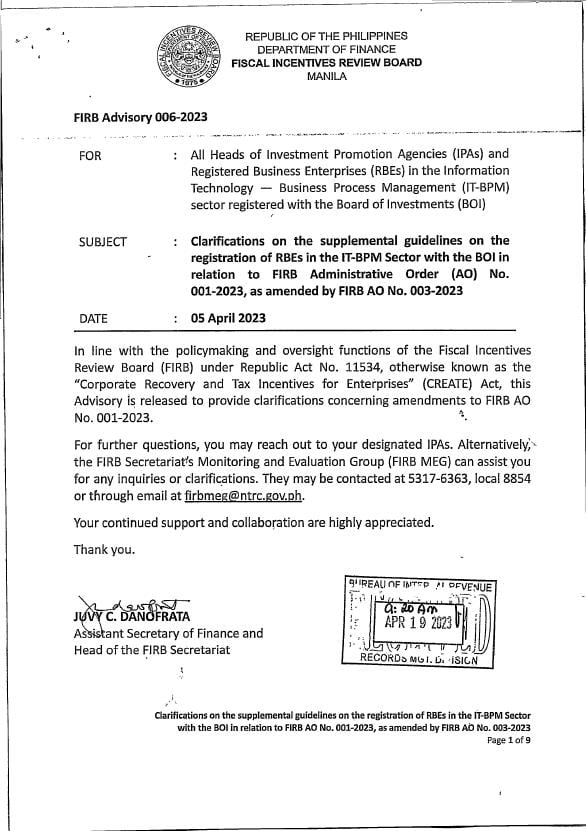
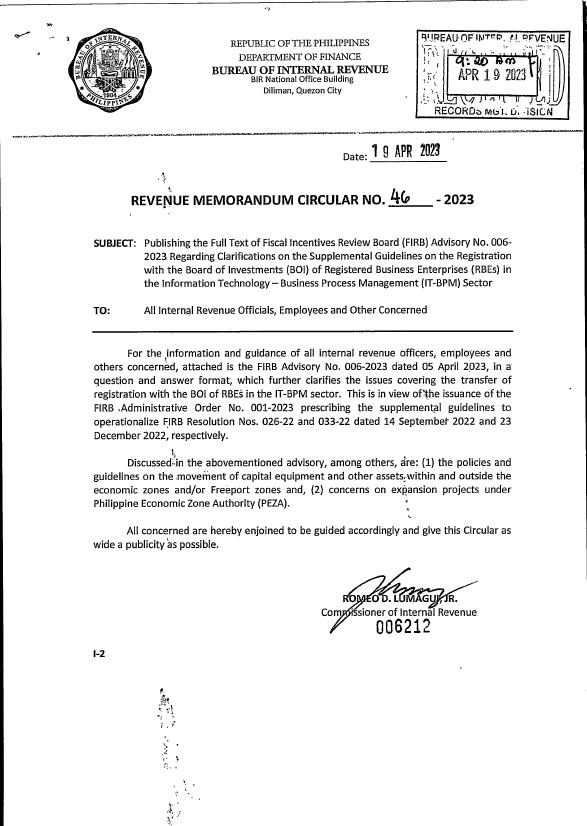
(FIRB Advisory 006-2023 dated April 05, 2023 and Revenue Memorandum Circular No. 46-2023, issued on April 19, 2023)
This Tax Alert is issued to inform all concerned on additional clarifications on the supplemental guidelines on the registration of Information Technology and Business Process Management (IT-BPM) Registered Business Enterprises (RBEs) with the Board of Investments (BOI).
Concerns on the movement of capital equipment and other assets within and outside the economic zones and/or freeport zones
- Only capital equipment and other assets related to the IT-BPM project or registered activity used to implement work-from-home (WFH) arrangement shall be covered by FIRB Administrative Order (AO) No. 001-2023, as amended.
- Only assets intended to be moved out of or already outside the economic zones and/or freeport zones used for WFH arrangements shall be required to secure a tax exemption indorsement (TEI).
- Existing goods imported as of January 31, 2023 shall be covered by a blanket TEI per project. Goods imported beginning February 1, 2023 shall be covered by a TEI per project per shipment.
- The TEI shall not be required for foreign-supplied intangible assets/software which will not pass through the Bureau of Customs (BOC) or any port. Only physically imported goods processed by the BOC shall be covered by the TEI.
- In case the intangible asset is a component of a tangible asset (e.g, part of equipment or machinery), the related TEI shall be secured. Since it shall form part of the imported asset, the cost of such intangible asset will be embedded in the purchase price of the physical asset that will be processed by the BOC.
- WFH arrangements may already be implemented pending the processing of the blanket TEI. However, movement of goods from the economic zones and/or freeport zones to implement WFH arrangements shall only be allowed upon successfully securing a provisional goods declaration (PGD) and submission of a notarized undertaking.
Concerns on existing assets imported as of January 31, 2023
- The bond-free transition period for existing assets shall be from January 1, 2023 to June 30, 2023.
- If IT-BPM RBEs are still securing the TEI after the lapse of the bond-free transition period, goods may still be allowed to be moved outside the economic zone, provided that a PGD has been secured and the specific and sufficient surety bond has already been posted, as approved by the BOC.
- However, in no case shall the TEI of existing assets currently outside the economic zone be secured later than one (1) year from the issuance of FIRB AO No. 003-2023 or the end of the bond-free transitory period, whichever comes later.
- The requirements and procedures regarding the processing of the PGD is prescribed in Customs Administrative Order No. 02-2021.
- If a blanket TEI has already been secured, a PGD need not be secured.
- The request for the staging bill of lading (BL) or dummy BL shall be filed to the BOC satellite offices for pre-assessment. Thereafter, the BOC satellite offices shall endorse the application for the approval of the BOC Deputy Collector for Operations and the BOC Deputy Collector for Assessment.
- The application for the staging BL/dummy BL shall be filed with the requirements prescribed by Annex A of FIRB AO. No. 001-2023, together with a pre-assessment entry, the related import documents, and a memorandum/letter addressed to the BOC Deputy Collector for Operations stating the grounds and basis for the approval of the request. The requirements and procedures for the staging BL/dummy BL are prescribed in Customs Memorandum Circular No. 22-2018.
- The inventory list of importations to be covered by the blanket TEI is required by the BOC for the processing of staging BL/dummy BL.
- If the transit-single administrative document (TSAD) is no longer available, the related import licenses issued by IPAs can be used in lieu of the TSAD.
- The staging BL/dummy BL shall be released within three (3) working days from the submission of complete documents.
- No specific format is prescribed for the letter request for staging BL/dummy BL. However, the request should be addressed to the Office of the Deputy Collector for Operations (ODCOPE).
- The staging BL/dummy BL is only required to secure the blanket TEI for existing assets. For new assets imported beginning February 1, 2023, an actual signed and dated Import BL/Air waybill is required.
Concerns on new assets imported beginning February 1, 2023
- The existing clearance procedures and documentary requirements of their concerned IPA shall apply to new importations of IT-BPM RBEs for the goods to be released from BOC custody. The additional procedure of securing a TEI shall only apply if the IT-BPM RBE requests for the movement of goods from the economic zone.
- As an additional control measure, the related import permit, admission permit, or any other equivalent document to be issued by the concerned IPA for all new importations must indicate an annotation stating that a TEI must be secured if the related assets will be moved out of the economic zone or freeport zone for WFH purposes.
- If the newly imported assets already need to be moved outside the economic or freeport zone and the IT-BPM RBEs are still securing the TEI, goods may still be allowed to be moved outside the economic zone, provided that a PGD has been secured, the specific and sufficient surety bond has already been posted, and an application for TEI has already been filed with the DOF-RO at the time of lodgment.
- However, in no case shall the TEI of existing assets currently outside the economic zone be secured later than one (1) year from the issuance of FIRB AO No. 003-2023 or the end of the bond-free transitory period, whichever comes later.
- The submission of the Certificate of Non-Local Availability (CNLA) for the processing of TEI shall be deferred pending the issuance of the joint memorandum circular by the DOF and DTI on how to operationalize the issuance of the CNLA.
Concerns on proof of entitlement to VAT incentives for local assets
- Generally, goods purchased locally for WFH arrangements subjected to VAT zero-rating should be supported by the related VAT zero-rating certificate issued by concerned IPA. Given the need to balance government control procedures and the ease of doing business, risk-based validation should be applied whenever possible.
Concerns on the valuation methods of the BOC for the sale, transfer, donation, or disposal of the related assets of the covered RBE, whether local or imported
- Fully depreciated assets with a useful life of five (5) years shall be assessed based on the 50% depreciated value using the valuation method prescribed under Section H.1 of FIRB AO No. 001-2023.
a) Net book value; or
b) Depreciated value using the straight-line depreciation method, with depreciation capped at 10% per year, but in no case shall it exceed 90%. Effectively, this assumes that the related equipment and other assets have a residual value of 10%, once fully depreciated.
c) The value to be used shall be whichever is higher between A and B.
- The valuation for asset disposal prescribed under Section H of FIRB AO No. 001-2023 shall also apply to locally purchased equipment qualified for VAT zero-rating. Such valuation method shall be applied prospectively. Hence, existing assets already disposed of prior to the IT-BPM RBE’s BOI registration shall not be covered by the valuation method.
Concerns on BOC procedures
- Cargoes shall still be subject to 100% inspection by the BOC even if the RBE is already registered with the BOI. The BOC shall validate if the goods listed in the submitted farm-out forms are the same as the goods to be taken out.
Concerns on expansion projects under PEZA
- An extension office (i.e, activity on the same building but on a different floor) shall be considered another project that needs to be registered for tax incentives separately if the operations entail an increase in the production capacity either through the installation of new IT equipment or the hiring of additional personnel. Meanwhile, if the extension office is intended merely for rearranging the office premises, there will be no additional incentives granted to the RBE and it shall just secure a letter of authority (LOA) from PEZA for the additional area of operations.
- IT-BPM RBEs registered with the PEZA and BOI are still required to maintain an office inside the PEZA-registered IT Centers/Buildings. Failure to comply shall result in the cancellation of its PEZA registration, and subsequently its BOI registration.
- PEZA rules and regulations shall still apply to the operations of IT-BPM RBEs registered with the BOI, including applications for office space reduction and transfer operations to a new location.
- The reduction of office space inside the economic zone shall be allowed provided that it must remain compliant with the required occupant density under the National Building Code of the Philippines (NBCP) and other existing rules and regulations of the concerned IPA.
- The application for the transfer of operations to a new location shall still be processed under PEZA. Once the letter of authority has been issued and the PEZA Certificate of Registration (COR) has been amended to reflect the new location, IT-BPM RBEs shall request for the endorsement of PEZA, for submission to the BOI, covering the changes in registration.
Concerns on the updating of BIR registration of IT-BPM transferees
- IT-BPM RBEs registered with the BOI are required to update their BIR COR. The IPA to be indicated in the updated COR shall be the new IPA followed by the old IPA, separated by a forward slash (e.g, BOI/PEZA or BOI/CDC). This shall also be the IPA indicated in the income tax return (ITR).
- RBEs with multiple registered activities under multiple IPAs shall accomplish additional sheets of BIR Form No. 1905. They shall inform the BIR revenue officer that there are multiple registered activities under multiple IPAs to be updated. The update may also be done through the BIR Online Registration and Update System (ORUS) (https://orus.bir.gov.ph/)