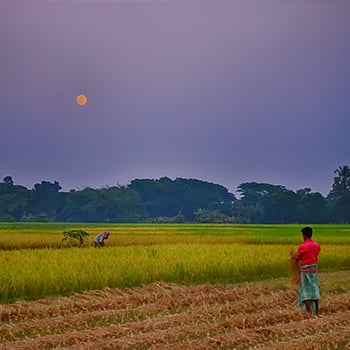


TO ACCELERATE the development of far-flung areas with good economic potential, we have to connect them by air to the major trade centers. This will require building or modernizing appropriate-capacity airports at government expense. To attract private air carriers to provide flights to these far-flung areas, a system of fare-subsidy to the carriers can be developed based on seat capacity utilization such that, when the capacity utilization reaches an agreed-upon rate, the subsidy ceases. Airports must be provided with night landing facilities so that the airlines can fly their otherwise idle aircraft to these rural destinations at night.
WE NEED to look long-term — beyond the six-year presidential term. There are a number of things we need to do and carry over the long term.
FROM THE END of the World War II to the early 1970s, the Philippines was commonly reported to be in a pole position economically among the neighboring countries constituting the present Association of Southeast Asian Nations (Asean). Since then, however, we have sharply lagged behind. We are now near the bottom of the pack.
THE NATIONAL issue of “endo” (short for end-of-contract or the termination of a worker’s fixed short-term employment) has been in the limelight for some time now, but has not seen its conclusion yet.
THE Local Government Code of 1991 decentralized local government units (LGUs) and, for this purpose, LGUs were given an annual allocation (allotment) of 40% of national tax collections (Internal Revenue Allotment or IRA). The IRA is in addition to the local taxes that the LGUs already impose and may impose in their respective jurisdictions. Now, after a long 28 years, this decentralization does not seem to have provided the improvements in the lives of our citizens that its proponents had argued as reason for its adoption.
THE NEW autonomous region in Muslim Mindanao, Bangsamoro Autonomous Region in Muslim Mindanao (BARMM), would have been inaugurated by the time this commentary gets into print. I am happy about this development, and I hope it will usher in a much more successful autonomous Muslim region than its predecessor had been. The entire country needs and, I am sure, wants it to be so.
DEMOCRACY can be defined in a variety of ways, from definitions with varying complexities to a rather simple one. Let us pick a basic and simple definition: a form of political association among the people of a state within a defined geographical area where sovereignty resides in the people who express such sovereignty by voting to select the leaders of the government of the state.
It may not be obvious to many; but elections in the Philippines are manifestly not competitive. A clear symbol of that condition is the apparent permanent existence of political dynasties, composing of 100 or so families in the Philippine political setting. It may be difficult to discern whether this permanence of political dynasties is the effect or the cause of improper election practices but, just the same, it may be worthwhile to highlight what I think are the two most significant election campaign practices that make our elections not competitive.