• Skip to content
  • Skip to navigation
Global site
Grant Thornton logo
  • Services
    • Audit & Assurance
      • Audit & Assurance
      • Annual and short period audit
      • Review engagement
      • Financial statements compilation
      • Security offerings services
      • Agreed-upon procedures
      • Other related services
    • Tax Advisory & Compliance
      • Tax Advisory & Compliance
      • Tax advisory
      • Tax compliance
      • Transfer pricing
      • Corporate services
      • Tax education and advocacy
    • Advisory Services
      • Advisory Services
      • Business risk services
      • Business consulting services
      • Transaction services
      • Forensic advisory
      • ProActive Hotline
      • Sustainability
      • P&A Academy
    • Business Process Solutions
      • Business Process Solutions
      • Accounting Services
      • Payroll Services
      • Human Capital Outsourcing Services
    • Japan Desk
  • Insights
  • About us
  • Events
  • Careers
    • Why Grant Thornton is a great place to work
      • Why Grant Thornton is a great place to work
      • Our values
      • Global culture
      • Learning & development
      • Global talent mobility
      • Diversity
      • In the community
      • Behind the Numbers: People of P&A Grant Thornton
    • Opportunities
      • Opportunities
      • Fresh Graduates
      • Students
      • Experienced hires
    • FAQs
  • Industries
    • Consumer products
    • Education
    • Energy and natural resources
    • Financial services
    • Not for profit
    • Outsourcing
    • Public sector
    • Real estate and construction
    • Technology, media and communications
    • Travel, tourism and leisure
    • Retail industry
Global site
  1. Home
  2. Alerts and Publications
  3. Technical Alerts
  4. Accounting Alerts
  5. 2024
  6. Guidelines on the Philippine Sustainable Finance Taxonomy

Accounting Alert

25 Mar 2024

Accounting Alerts

  • 2024
  • 2023
  • 2022
  • 2021
  • 2020 2020
    • Extension of Deadline for Submission of Forms/Notices
    • Online and Manual Submission of Forms/Notices Pursuant to SEC MC 28-2020
    • COVID-19 Accounting Implications for CFOs - Debt Modifications
    • Discussion Paper 'Business Combination under Common Control'
    • SEC Memorandum Circular No. 32 series of 2020
    • SEC Memorandum Circular No. 31 series of 2020
    • SEC Memorandum Circular No. 28 series of 2020
    • Insights into PFRS 16 - Lease Incentives
    • IASB issues Interest Rate Benchmark Reform Phase 2
    • IFRIC 23 - Uncertainty Over Income Tax Treatments
    • COVID-19 Going Concern Considerations
    • Extension of Deadlines and Interim Procedures for the Submission of Printed/Hard Copies of Annual Reports
    • IASB Defers the Effective Date of IAS 1 Amendments
    • Guidelines on the Electronic Submission of the Annual Report and Audited Financial Statements to BSP
    • Filing of Annual Reports During the Temporary Closure of the SEC Main Office until July 26, 2020
    • Work Suspension at the SEC Main Office and Extension of Deadlines for Certain Corporations
    • Adjustment of Deadlines for Submission of Annual Reports to the SEC and Other Announcements
    • Amendments to IFRS 17 and IFRS 4
    • Filing of Reports and Other Documents in SEC Main Office during Temporary Closure
    • Options for the Submission of Reports, Applications and Other Documents to the SEC During Community Quarantine
  • 2019 2019
    • SEC Extends Deadline for Annual and Quarterly Reports for...
    • Deferral of IFRIC Agenda Decision on Over Time Transfer of Constructed Goods (PAS 23) for Real Estate Industry
    • Implementation of IFRS 17, Insurance Contracts
    • Amendments to Regulations on Financial Audit of Banks and Non-Bank Financial Institutions
    • Navigating the Changes to IFRS 2020
    • SEC Memorandum Circular No. 2 - 2020 Filing of Annual Financial Statements and General Information Sheet
    • IASB issues Classification of Liabilities as Current or Non-current (Amendments to IAS 1)
    • GTI IFRS News Q4 2019
    • Insights into PFRS 3: Definition of a Business
    • IASB issues Interest Rate Benchmark Reform
    • Insights into PFRS 16: Presentation and Disclosure
    • Insights into PFRS 16: Lease Payments
    • Insurance Commission's Guidelines on Lease Accounting for Insurance and Reinsurance Companies
    • GTI IFRS News Q1 2019
    • Application Deferral of PIC Q&A 2018-H and 2018-14
    • Sustainability Reporting Guidelines for Publicly-Listed Companies
    • Insights into PFRS 16: Sale and Leaseback Accounting
    • Insights into PFRS 16: Transition Choices
    • Use of the New General Information Sheet (GIS) Form
    • 2019 Filing of Annual FS and GIS
    • Navigating the Changes to IFRS 18
    • Insights into PFRS 3: Definition of a Business
    • GTI IFRS News Q2 2019
    • Rules on Material Related Party Transactions for Publicly-listed Companies
    • BOA Repealed Resolutions on FS Compilation Services
    • GTI IFRS News Q3 2019
    • 2019
  • 2018 2018
    • Insights into IFRS 16
    • SEC Memorandum Circular 2018-14 – PFRS 15 Implementation Issues Affecting Real Estate Industry
    • Accounting for Client Money
    • Third Quarter Edition of IFRS News
    • Accounting for Crypto Assets
  • 2017
  • 2016
  • 2015
  • 2014
  • 2008
  • 2007
  • 2006
  • 2005

Guidelines on the Philippine Sustainable Finance Taxonomy

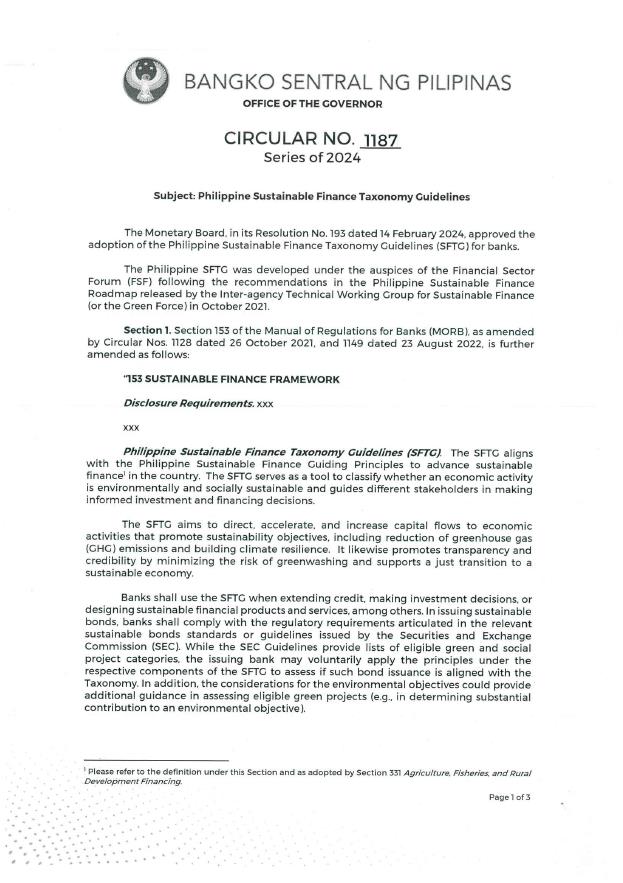
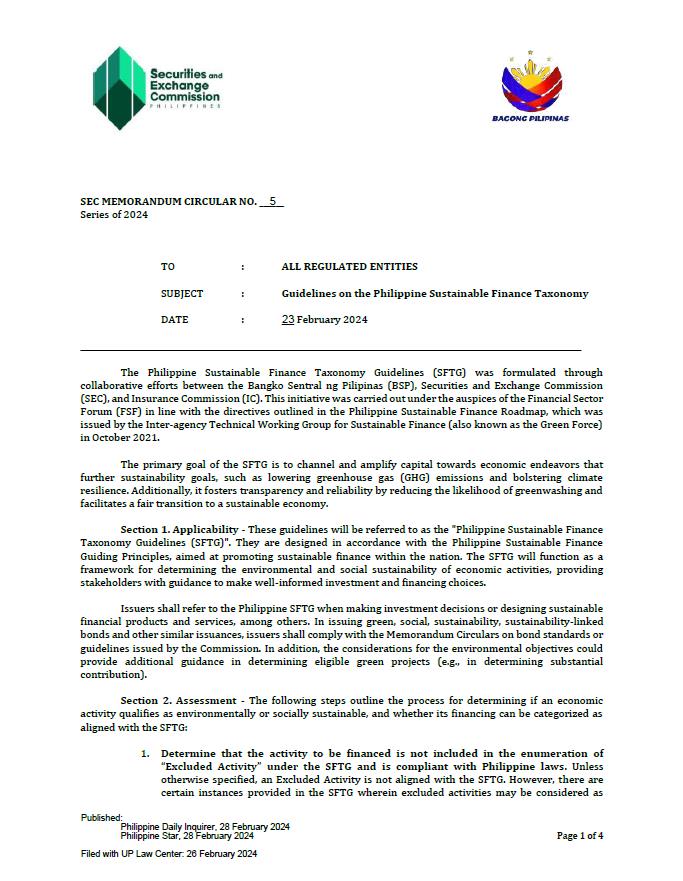
This Accounting Alert is issued to circulate Bangko Sentral ng Pilipinas (BSP) Circular No. 1187 dated February 21, 2024, and Securities and Exchange Commission (SEC) Memorandum Circular No. 5-2024 dated February 23, 2024, which both discuss the "Philippine Sustainable Finance Taxonomy Guidelines (SFTG)".

Section 1: Applicability

SFTG is designed in accordance with the Philippine Sustainable Finance Guiding Principles, aimed at promoting sustainable finance within the nation. The SFTG will function as a framework for determining the environmental and social sustainability of economic activities, providing stakeholders with guidance to make well-informed investment and financing choices.

Section 2: Assessment

The following steps outline the process for determining if an economic activity qualifies as environmentally or socially sustainable, and whether its financing can be categorized as aligned with the SFTG:

  1. Determine that the activity to be financed is not included in the enumeration of “Excluded Activity” under the SFTG and is compliant with Philippine laws.
  2. Select the relevant Environmental Objective (EO) of the activity.
  3. Assess whether the activity significantly harms the other EO.
  4. If there is harm, verify that the same has been remediated or will be remediated within the required defined period.

The SFTG provides a set of guiding questions and decision trees to support the regulated entities’ assessment. In addition, entities undertaking the economic activity should comply, at a minimum, with the Philippine social safeguard requirements.

After the assessment process, economic activities may be classified as Green, Amber or Red, following the definitions under the SFTG.  An activity that falls under the Red classification does not imply that the activity is unsustainable. Rather, the subject activity does not meet the higher sustainability ambition of the SFTG or pass the Do No Significant Harm (DNSH) or minimum social safeguards tests. The activity classified as Red may still be eligible for "unlabeled" financing.

The details of the Philippine SFTG are provided in the Annex 1 of the Memorandum Circular.

Section 3: Compliance

Regulated entities are directed to deepen understanding and familiarity with the SFTG and are encouraged to take into consideration its provisions and prescribed standards.

Please see attached circulars for further information.

.

BSP Circular No. 1187

image/jpeg [87 kb]
rich text with download pdf

.

SEC MC No. 5-2024

Download PDF [1446 kb]
rich text with download pdf
Download PDF [1446 kb]
Share this page
  • Facebook
  • Twitter
  • LinkedIn
  • WhatsApp
  • Email

CONNECT CONNECT

  • Meet Our People
  • Contact us
  • Locations

ABOUT ABOUT

  • Careers
  • News Centre
  • ProActive Hotline

LEGAL LEGAL

  • Privacy
  • Cookie policy
  • Disclaimer
  • Site map
  • Cookie Preferences

Our Core Services Our Core Services

  • Audit and Assurance
  • Tax Advisory and Compliance
  • Advisory Services
  • Outsourcing and Managed Services
  • Japan Desk

Follow usFollow us

‘Grant Thornton’ refers to the brand under which the Grant Thornton member firms provide services to their clients and/or refers to one or more member firms, as the context requires. ‘GTIL’ refers to Grant Thornton International Ltd (GTIL). P&A Grant Thornton is a member firm of GTIL. GTIL and each member firm of GTIL is a separate legal entity. GTIL is a nonpracticing, international coordinating entity organised as a private company limited by guarantee incorporated in England and Wales. GTIL does not deliver services in its own name or at all. Services are delivered by the member firms. GTIL and its member firms are not agents of, and do not obligate, one another and are not liable for one another’s acts or omissions. The name ‘Grant Thornton’, the Grant Thornton logo, including the Mobius symbol/ device are trademarks of GTIL. All copyright is owned by GTIL, including the copyright in the Grant Thornton logo; all rights are reserved.