• Skip to content
  • Skip to navigation
Global site
Grant Thornton logo
  • Services
    • Audit & Assurance
      • Audit & Assurance
      • Annual and short period audit
      • Review engagement
      • Financial statements compilation
      • Security offerings services
      • Agreed-upon procedures
      • Other related services
    • Tax Advisory & Compliance
      • Tax Advisory & Compliance
      • Tax advisory
      • Tax compliance
      • Transfer pricing
      • Corporate services
      • Tax education and advocacy
    • Advisory Services
      • Advisory Services
      • Business risk services
      • Business consulting services
      • Transaction services
      • Forensic advisory
      • ProActive Hotline
      • Sustainability
      • P&A Academy
    • Business Process Solutions
      • Business Process Solutions
      • Accounting Services
      • Payroll Services
      • Human Capital Outsourcing Services
    • Japan Desk
  • Insights
  • About us
  • Events
  • Careers
    • Why Grant Thornton is a great place to work
      • Why Grant Thornton is a great place to work
      • Our values
      • Global culture
      • Learning & development
      • Global talent mobility
      • Diversity
      • In the community
      • Behind the Numbers: People of P&A Grant Thornton
    • Opportunities
      • Opportunities
      • Fresh Graduates
      • Students
      • Experienced hires
    • FAQs
  • Industries
    • Consumer products
    • Education
    • Energy and natural resources
    • Financial services
    • Not for profit
    • Outsourcing
    • Public sector
    • Real estate and construction
    • Technology, media and communications
    • Travel, tourism and leisure
    • Retail industry
Global site
  1. Home
  2. Alerts and Publications
  3. Technical Alerts
  4. Accounting Alerts
  5. 2023
  6. Insights into PFRS 3, Business Combination

Accounting Alert

17 Nov 2023

Accounting Alerts

  • 2024
  • 2023
  • 2022
  • 2021
  • 2020 2020
    • Extension of Deadline for Submission of Forms/Notices
    • Online and Manual Submission of Forms/Notices Pursuant to SEC MC 28-2020
    • COVID-19 Accounting Implications for CFOs - Debt Modifications
    • Discussion Paper 'Business Combination under Common Control'
    • SEC Memorandum Circular No. 32 series of 2020
    • SEC Memorandum Circular No. 31 series of 2020
    • SEC Memorandum Circular No. 28 series of 2020
    • Insights into PFRS 16 - Lease Incentives
    • IASB issues Interest Rate Benchmark Reform Phase 2
    • IFRIC 23 - Uncertainty Over Income Tax Treatments
    • COVID-19 Going Concern Considerations
    • Extension of Deadlines and Interim Procedures for the Submission of Printed/Hard Copies of Annual Reports
    • IASB Defers the Effective Date of IAS 1 Amendments
    • Guidelines on the Electronic Submission of the Annual Report and Audited Financial Statements to BSP
    • Filing of Annual Reports During the Temporary Closure of the SEC Main Office until July 26, 2020
    • Work Suspension at the SEC Main Office and Extension of Deadlines for Certain Corporations
    • Adjustment of Deadlines for Submission of Annual Reports to the SEC and Other Announcements
    • Amendments to IFRS 17 and IFRS 4
    • Filing of Reports and Other Documents in SEC Main Office during Temporary Closure
    • Options for the Submission of Reports, Applications and Other Documents to the SEC During Community Quarantine
  • 2019 2019
    • SEC Extends Deadline for Annual and Quarterly Reports for...
    • Deferral of IFRIC Agenda Decision on Over Time Transfer of Constructed Goods (PAS 23) for Real Estate Industry
    • Implementation of IFRS 17, Insurance Contracts
    • Amendments to Regulations on Financial Audit of Banks and Non-Bank Financial Institutions
    • Navigating the Changes to IFRS 2020
    • SEC Memorandum Circular No. 2 - 2020 Filing of Annual Financial Statements and General Information Sheet
    • IASB issues Classification of Liabilities as Current or Non-current (Amendments to IAS 1)
    • GTI IFRS News Q4 2019
    • Insights into PFRS 3: Definition of a Business
    • IASB issues Interest Rate Benchmark Reform
    • Insights into PFRS 16: Presentation and Disclosure
    • Insights into PFRS 16: Lease Payments
    • Insurance Commission's Guidelines on Lease Accounting for Insurance and Reinsurance Companies
    • GTI IFRS News Q1 2019
    • Application Deferral of PIC Q&A 2018-H and 2018-14
    • Sustainability Reporting Guidelines for Publicly-Listed Companies
    • Insights into PFRS 16: Sale and Leaseback Accounting
    • Insights into PFRS 16: Transition Choices
    • Use of the New General Information Sheet (GIS) Form
    • 2019 Filing of Annual FS and GIS
    • Navigating the Changes to IFRS 18
    • Insights into PFRS 3: Definition of a Business
    • GTI IFRS News Q2 2019
    • Rules on Material Related Party Transactions for Publicly-listed Companies
    • BOA Repealed Resolutions on FS Compilation Services
    • GTI IFRS News Q3 2019
    • 2019
  • 2018 2018
    • Insights into IFRS 16
    • SEC Memorandum Circular 2018-14 – PFRS 15 Implementation Issues Affecting Real Estate Industry
    • Accounting for Client Money
    • Third Quarter Edition of IFRS News
    • Accounting for Crypto Assets
  • 2017
  • 2016
  • 2015
  • 2014
  • 2008
  • 2007
  • 2006
  • 2005

Insights into PFRS 3, Business Combination

This Accounting Alert is issued to provide an overview of Philippine Financial Reporting Standards (PFRS) 3, Business Combination highlighting the aspects that are challenging to interpret and apply in practice. This includes the present guidance on PFRS' requirements for recognizing and measuring non-controlling interests (NCI), determining and measuring the amount of consideration transferred, and determining what is part of a business combination in cases where there are other transactions and arrangements between parties.

Overview

Mergers and acquisitions (business combinations) can have a fundamental impact on the acquirer’s operations, resources and strategies. For most entities such transactions are infrequent, and each is unique. PFRS 3, Business Combinations, contains the requirements for these transactions, which can be challenging in practice. The Standard itself has now been in place for more than ten years and has undergone a comprehensive post implementation review by the International Accounting Standards Board (IASB).

This article contains the present guidance on PFRS' requirements for the following:

  • Recognizing and measuring NCI
  • Determining and measuring the amount of consideration transferred
  • Determining what is part of a business combination in cases where there are other transactions and arrangements between parties

Recognizing and measuring NCI

PFRS 3 defines NCI as 'the equity in a subsidiary not attributable, directly or indirectly, to a parent. The simplest and most common form of NCI is shares in the acquiree held by non-selling shareholders. However, all instruments issued by the acquiree that meet the definition of equity set out in PAS 32, Financial Instruments: Presentation - such as share options, preferred shares, equity component of convertible bonds are also NCI if they are not owned or acquired by the acquirer.

Depending on the nature and the rights those equity instruments entitle their holders, NCI can be grouped into two broad categories, which in turn determine the available measurement options at initial recognition.

  1. Present ownership interests - Measured at far value or proportionate share of recognized amount of assets and liabilities of the acquiree. The choice between the two measurement options is to be made for each business combination on a transaction-by-transaction basis.
  2. All other equity instruments not held directly or indirectly by the acquirer - Measured at fair value unless another measurement basis is required by PFRS, e.g. share-based payment awards classified as equity and held by parties other than the acquirer are measured in accordance with PFRS 2, Share Based Payment.

Determining and measuring the amount of consideration transferred

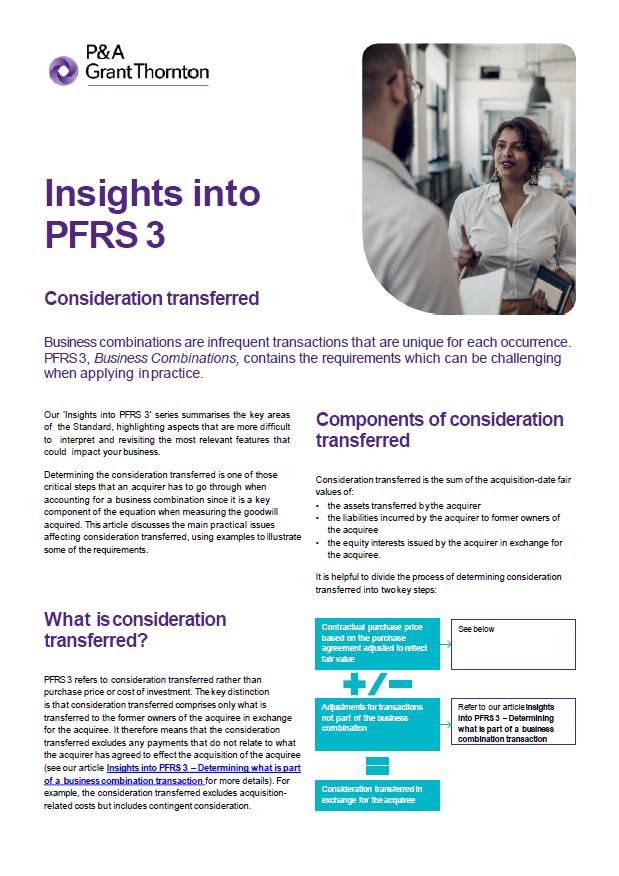
Consideration transferred is the sum of the acquisition date-fair values of:

  • the assets transferred by the acquirer
  • the liabilities incurred by the acquirer to former owners of the acquiree
  • the equity interests issued by the acquirer in exchange of the acquiree

Consideration transferred could differ from the contractual purchase price for different reasons. One of the reasons could be if the overall transaction or arrangement includes elements that are not part of the business combination. It could also be because the fair value of the consideration transferred at the date of acquisition is not the same as the amount stated in the contractual arrangement to determine the purchase price. Consideration transferred may include the following:

Deferred consideration is an obligation to pay a certain amount at a specified date after the date of acquisition. This is measured at fair value at the acquisition date (considering the time value of money). The unwinding of the discount is recognized in profit or loss.​

Contingent consideration is the obligation of the acquirer to transfer additional assets or equity interests to the acquiree’s former owners if specified future events occur or conditions are met.

Specific considerations also apply to:

Share-for-share exchanges and combinations of mutual entities -  Under PFRS 3, consideration transferred is determined based on the fair value of the shares issued by the acquirer. However, PFRS 3 provides a mandatory alternative if the shares acquired are more reliably measurable. The consideration transferred is measured using the acquisition-date fair value of the acquiree’s equity interests received if this fair value is more reliably measurable than the acquisition-date fair value of the acquirer’s equity interests transferred. For business combinations of mutual entities, the same principle also apply.

Business combinations with no consideration transferred - Even if no consideration is transferred in certain situations, the acquisition method shall still be applied. To determine the amount of goodwill when no consideration is transferred, the acquirer must substitute the fair value of any consideration transferred with the acquisition-date fair value of the acquirer's interest in the acquiree (determined using an appropriate valuation technique). 

Business combination achieved by contract alone - The acquirer can hold no equity interest in the acquiree before or after the acquisition date. In such situations, the acquirer must attribute all of the equity interest held by parties other the acquirer as non-controlling interest (NCI), even if this results in 100% NCI.

Determining what is part of a business combination transaction

In effecting a business combination, the acquirer may also enter into transactions and arrangements with the vendor and/or acquiree. Under PFRS 3, the acquirer should determine whether such a transaction is part of the exchange for the acquiree. If not, the transaction must be accounted for separately.

PFRS 3 provides a list of indicators to be considered when determining whether a transaction is part of the exchange for the acquiree or a separate transaction. The indicators are neither mutually exclusive nor individually conclusive.

  • A transaction arranged primarily for the benefit of the acquirer or the combined entity (i.e., acquirer and acquiree) is less likely to be part of the exchange for the acquiree.
  • A transaction or other event initiated by the acquirer with the objective of providing future economic benefits to the acquirer or the combined entity is less likely to be part of the exchange for the acquiree.
  • A transaction entered into between the acquirer and the acquiree during the negotiations of the terms of the business combination, with the objective of providing future economic benefits to the acquirer or the combined entity is less likely to be part of the exchange for the acquiree.

PFRS 3 provides three examples of transactions that should be accounted for separately from the business combination and provides guidance on how these transactions affect the calculation of the consideration transferred, if any:

  • In effect settles pre-existing relationships between the parties
  • Remunerates employees or former owners of the acquiree for future services
  • Reimburses the acquiree or its former owners for paying the acquirer’s acquisition-related costs.


See attached files for further details and illustrative examples.

.

Insights into PFRS 3 - Recognising and measuring non-controlling interests

Download PDF [226 kb]
rich text with download pdf
Download PDF [226 kb]

.

Insights into PFRS 3 - Consideration Transferred

Download PDF [295 kb]
rich text with download pdf
Download PDF [295 kb]

.

Insights into PFRS 3 - What is part of a business combination transactions

Download PDF [358 kb]
rich text with download pdf
Download PDF [358 kb]

CONNECT CONNECT

  • Meet Our People
  • Contact us
  • Locations

ABOUT ABOUT

  • Careers
  • News Centre
  • ProActive Hotline

LEGAL LEGAL

  • Privacy
  • Cookie policy
  • Disclaimer
  • Site map
  • Cookie Preferences

Our Core Services Our Core Services

  • Audit and Assurance
  • Tax Advisory and Compliance
  • Advisory Services
  • Outsourcing and Managed Services
  • Japan Desk

Follow usFollow us

‘Grant Thornton’ refers to the brand under which the Grant Thornton member firms provide services to their clients and/or refers to one or more member firms, as the context requires. ‘GTIL’ refers to Grant Thornton International Ltd (GTIL). P&A Grant Thornton is a member firm of GTIL. GTIL and each member firm of GTIL is a separate legal entity. GTIL is a nonpracticing, international coordinating entity organised as a private company limited by guarantee incorporated in England and Wales. GTIL does not deliver services in its own name or at all. Services are delivered by the member firms. GTIL and its member firms are not agents of, and do not obligate, one another and are not liable for one another’s acts or omissions. The name ‘Grant Thornton’, the Grant Thornton logo, including the Mobius symbol/ device are trademarks of GTIL. All copyright is owned by GTIL, including the copyright in the Grant Thornton logo; all rights are reserved.