Accounting Alerts
- 2024
- 2023
- 2022
- 2021
-
2020
2020
- Extension of Deadline for Submission of Forms/Notices
- Online and Manual Submission of Forms/Notices Pursuant to SEC MC 28-2020
- COVID-19 Accounting Implications for CFOs - Debt Modifications
- Discussion Paper 'Business Combination under Common Control'
- SEC Memorandum Circular No. 32 series of 2020
- SEC Memorandum Circular No. 31 series of 2020
- SEC Memorandum Circular No. 28 series of 2020
- Insights into PFRS 16 - Lease Incentives
- IASB issues Interest Rate Benchmark Reform Phase 2
- IFRIC 23 - Uncertainty Over Income Tax Treatments
- COVID-19 Going Concern Considerations
- Extension of Deadlines and Interim Procedures for the Submission of Printed/Hard Copies of Annual Reports
- IASB Defers the Effective Date of IAS 1 Amendments
- Guidelines on the Electronic Submission of the Annual Report and Audited Financial Statements to BSP
- Filing of Annual Reports During the Temporary Closure of the SEC Main Office until July 26, 2020
- Work Suspension at the SEC Main Office and Extension of Deadlines for Certain Corporations
- Adjustment of Deadlines for Submission of Annual Reports to the SEC and Other Announcements
- Amendments to IFRS 17 and IFRS 4
- Filing of Reports and Other Documents in SEC Main Office during Temporary Closure
- Options for the Submission of Reports, Applications and Other Documents to the SEC During Community Quarantine
-
2019
2019
- SEC Extends Deadline for Annual and Quarterly Reports for...
- Deferral of IFRIC Agenda Decision on Over Time Transfer of Constructed Goods (PAS 23) for Real Estate Industry
- Implementation of IFRS 17, Insurance Contracts
- Amendments to Regulations on Financial Audit of Banks and Non-Bank Financial Institutions
- Navigating the Changes to IFRS 2020
- SEC Memorandum Circular No. 2 - 2020 Filing of Annual Financial Statements and General Information Sheet
- IASB issues Classification of Liabilities as Current or Non-current (Amendments to IAS 1)
- GTI IFRS News Q4 2019
- Insights into PFRS 3: Definition of a Business
- IASB issues Interest Rate Benchmark Reform
- Insights into PFRS 16: Presentation and Disclosure
- Insights into PFRS 16: Lease Payments
- Insurance Commission's Guidelines on Lease Accounting for Insurance and Reinsurance Companies
- GTI IFRS News Q1 2019
- Application Deferral of PIC Q&A 2018-H and 2018-14
- Sustainability Reporting Guidelines for Publicly-Listed Companies
- Insights into PFRS 16: Sale and Leaseback Accounting
- Insights into PFRS 16: Transition Choices
- Use of the New General Information Sheet (GIS) Form
- 2019 Filing of Annual FS and GIS
- Navigating the Changes to IFRS 18
- Insights into PFRS 3: Definition of a Business
- GTI IFRS News Q2 2019
- Rules on Material Related Party Transactions for Publicly-listed Companies
- BOA Repealed Resolutions on FS Compilation Services
- GTI IFRS News Q3 2019
- 2019
- 2018 2018
- 2017
- 2016
- 2015
- 2014
- 2008
- 2007
- 2006
- 2005
Guidance on Making Materiality Judgments
The International Accounting Standards Board (IASB) issued International Financial Reporting Standards (IFRS) Practice Statement 2 entitled "Making Materiality Judgments". The Practice Statement encourages entities to apply judgement so that financial statements focus on information that is valuable to investors rather than trying to comply with an IFRS 'checklist'.
Background of and Main issues addressed by the Practice Statement
The concept of materiality is important in the preparation of financial statements because it helps entities determine which information shall be included in their reports. However, management often encounter uncertainty in applying the concept of materiality, thereby leading them to view the IFRS Standards as a checklist than a principle-based guide in judging which information would be most useful to investors and other stakeholders.
With this Practice Statement, the IASB is providing support to entities in making judgment on materiality and hopes to elevate behavior on financial reporting by promoting greater application of judgment. The Practice Statement provides guidance on the following:
(1) general characteristics of materiality
(2) interaction of laws and regulations with materiality
(3) a four-step materiality judgment process, and
(4) specific application guidance on prior period information, errors, information about covenants and interim reporting.
The four-step materiality judgment process
The four step materiality judgment process requires the performance of the following procedures:
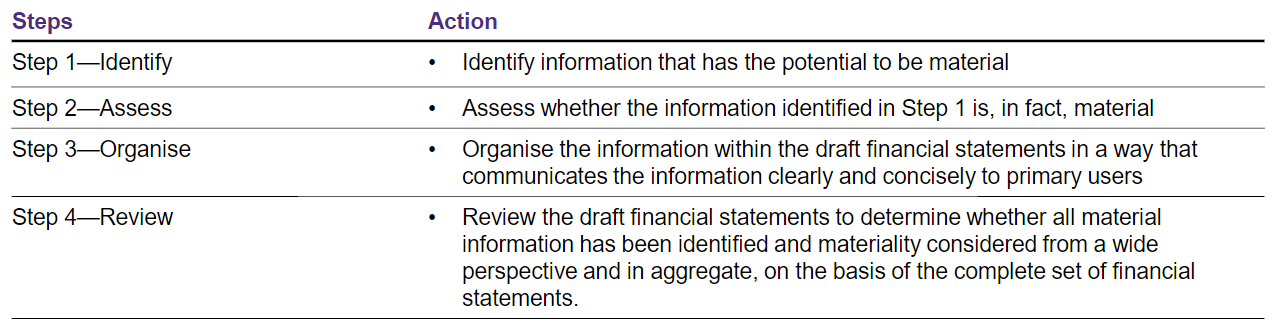
The Practice Statement is not a Standard and its application is not mandatory to comply with the IFRS. It does not change existing requirements but aims to provide guidance on making materiality judgments in preparing the financial statements.
Download the Guidance on Making Materiality Judgments.
.
Guidance on Making Materiality Judgments