

Understanding internal and external comparables in Transfer Pricing: Choosing the right benchmark
A fundamental aspect of transfer pricing (TP) analysis is determining whether transactions between related parties are conducted at arm’s length. The arm’s length principle requires that transactions between associated enterprises be priced as if they were conducted between independent parties under comparable circumstances.
To assess this, taxpayers and tax authorities rely on comparable transactions or companies as benchmarks. Understanding the distinction between internal and external comparables is essential, as the selection of appropriate comparables significantly impacts the reliability of a TP study and the defensibility of transfer pricing positions during audits.
Internal comparables
Internal comparables refer to transactions undertaken by the tested party with independent third parties that are comparable to the controlled transaction under review. Because these transactions involve the same entity, differences in business strategies, accounting policies, market conditions, and operational structures are generally minimized.
For example, if a company provides accounting services to both related and unrelated parties, the pricing charged to independent customers may serve as an internal comparable, provided that the scope of services, contractual terms, and economic circumstances are sufficiently comparable.
Internal comparables are generally preferred when they are sufficiently comparable. However, they may not always be available in practice, and even where they exist, material differences may limit their reliability if such differences cannot be reliably adjusted. In these situations, taxpayers may need to rely on external comparables obtained from commercial databases, publicly available information, or other sources of market data.
External comparables
External comparables involve transactions or companies that are not related to the tested party but operate under comparable circumstances. These are typically identified through commercial databases, publicly available financial information, industry reports, and other sources of market data.
For instance, where reliable internal comparables are unavailable, a TP practitioner may identify third-party companies performing comparable functions, utilizing similar assets, and assuming comparable risks. The profitability or, in certain cases, pricing information derived from these companies or transactions can then be used as a benchmark for testing the arm's length nature of the related-party transaction.
While external comparables are widely used in practice, they often require a more rigorous comparability analysis. Differences in scale, geographic markets, business models, accounting standards, and risk profiles may necessitate adjustments to improve reliability.
Key considerations in selecting comparables
Whether using internal or external comparables, taxpayers should evaluate comparability based on several factors, including:
- Characteristics of the goods or services involved;
- Functions performed, assets employed, and risks assumed (FAR analysis);
- Contractual terms of the transaction;
- Economic circumstances and market conditions; and
- Business strategies adopted by the parties.
A robust comparability analysis helps ensure that transfer pricing outcomes accurately reflect market conditions and supports compliance with local TP regulations and international standards.
Internal vs. external comparables
To summarize the key distinctions between the two types of comparables, the table below provides a side-by-side comparison of internal and external comparables commonly used in transfer pricing analyses.
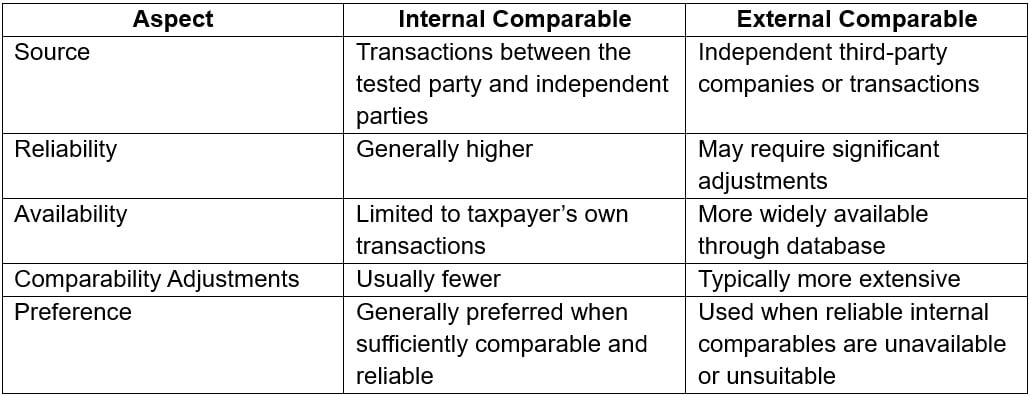
Ultimately, the objective is not necessarily to select an internal or external comparable, but rather to identify the most reliable comparable data available based on the facts and circumstances of the controlled transaction.
(Chapter III – Comparability Analysis, OECD Transfer Pricing Guidelines, January 2022, BIR RR No. 2-2013 and RAMO No. 1-2019)
Selecting appropriate comparables is one of the most critical components of a transfer pricing analysis. While internal comparables are generally preferred when they provide the most reliable basis for comparison, external comparables remain an important alternative when internal data is unavailable or less reliable. Taxpayers should ensure that their comparability analysis is well-documented, supported by reliable data, and aligned with applicable TP regulations. A carefully prepared benchmarking study not only strengthens transfer pricing compliance, but also helps mitigate potential tax adjustments and disputes during audits.