

Circularizing Department of Finance (DOF) Order No. 026-2026 on the terms and conditions on the grant of the Enhanced Deduction Regime
(Revenue Memorandum Circular No. 105-2026 posted on BIR website on 29 September 2026)
This Tax Alert is issued to inform Registered Business Enterprises (RBEs) availing of the Enhanced Deduction Regime (EDR) of the requirements and conditions under Department Order No. 026-2026.
Covered taxpayers
The Order applies to:
- Registered Domestic Market Enterprises (DMEs), including High-Value DMEs, which were granted EDR incentives;
- Registered Export Enterprises (REEs) that elected the EDR upon registration; and
- Pre-CREATE RBEs that transferred their registration under CREATE MORE and opted to avail of the EDR.
Enhanced deductions available
In addition to the ordinary and necessary deductions allowed under the Tax Code, qualified RBEs may claim the following enhanced deductions:
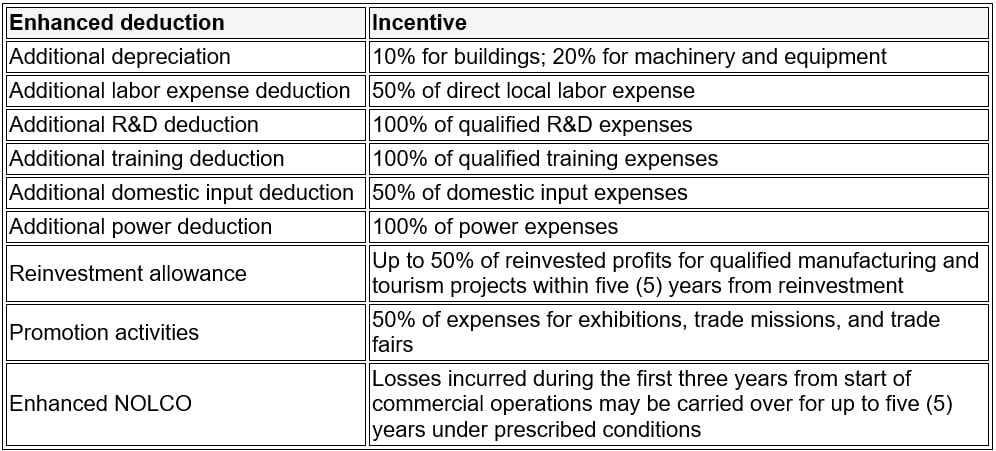
Key compliance requirements
Manner of application
Enhanced deductions shall be applied only after determination of gross income and the deductions of ordinary and necessary operating expenses.
Direct project attribution and cost allocation
Expenses must be directly related to the registered project or activity. Enterprises with multiple registered projects must maintain separate books. Common expenses shall be allocated using method applied consistently across all incentive periods. Allocation process shall be disclosed in the Notes to AFS. Permitted methods include revenue allocation, cost allocation, and number of employees.
Related-party transactions
Enhanced deductions arising from related-party transactions will generally be disallowed unless the taxpayer can demonstrate that the transactions were conducted at arm's length and supported by appropriate documentation.
Minimum Corporate Income Tax (MCIT)
RBEs under EDR shall be subject to MCIT, when the MCIT is greater than the RCIT computed after the EDR has been applied.
Significant conditions for specific incentives
Additional depreciation
Shall exclude assets used for administrative and other support or auxiliary services, such as service vehicles. Assets must be owned by the RBE. Incentives shall not apply to second-hand machinery and equipment, unless allowed by the SIPP. Right-of-use assets may be claimed, subject to rules under PFRS 16 and RMC No. 11-2024.
Additional labor expense deduction
Only direct local employees directly hired by the RBE and engaged in the registered activity qualify. Managerial, administrative, indirect labor, outsourced personnel, contractors, and support services are excluded.
Additional R&D deduction
The additional 100% deduction is limited to local expenditures relating to salaries of Filipino employees, consumables, and payments to local R&D organizations. RBEs must submit an R&D proposal to the concerned IPA and secure endorsement from the relevant government agency. The following are excluded activities, including market research, exploration activities, feasibility studies, social science research, patent and licensing, and software customization for internal administration.
Additional training Deduction
Only technical training directly related to the registered activity qualifies. It must be approved by the IPA and given only to the direct Filipino employees. Executive education programs, team-building activities, CPD and MCLE compliance programs, and legally mandated seminars are expressly excluded.
Domestic input deduction
RBE shall include a notarized comprehensive summary report, a detailed computation showing compliance with the value addition requirements of at least 50%. Certain support services, such as consulting, legal, marketing, and administrative services, do not qualify: however, services directly integrated into core operational processes may qualify.
Power expense deduction
Only actual electricity costs utilized for registered operations qualify. Penalties, surcharges, and similar charges are excluded.
Deduction for reinvestment allowance
RBEs in manufacturing and tourism industries that reinvest their undistributed profit or surplus shall be allowed to avail only until 31 December 2034. RBE must show proof of actual cash and/or capital expenditure reinvested. To substantiate the reinvestment allowance, the RBE must submit to the IPA as an attachment to the notarized comprehensive summary: board or partnership resolutions authorizing the appropriation of the undistributed profit for reinvestment. Additional disclosure to Notes to AFS must be included. Investments in debt securities, index funds, pension funds, and other similar investments in another RBE are excluded.
Promotion activities
RBEs may claim additional deduction of 50% on expenses related to exhibitions, trade missions, or trade fairs, including expenses in promoting exports of goods or services to foreign markets approved by the IPA. Trade shows or events for domestic markets are excluded.
Enhanced NOLCO
Regular and enhanced NOLCO shall be allowed only if there has been no substantial change in the ownership of the enterprise. RBE shall submit its general information sheet, sworn statement of list of beneficial owners or sworn statement of no change in stockholders and partners or board resolutions or secretary’s certificate.
New reporting and filing requirements
RBEs shall submit to their concerned Investment Promotion Agency (IPA) a Notarized Comprehensive Summary Report (NCSR) detailing all enhanced deductions claimed in the ITR using prescribed templates. The report must include, among others:
- Types and amounts of enhanced deductions claimed;
- Expense allocation methodologies used;
- Compliance checklist for substantiation requirements;
- Details of reinvestment allowance and enhanced NOLCO claims; and
- Approval status of trainings and export promotion activities subject to IPA review.
The NCSR is on a per project basis. It must be submitted within 30 calendar days from the filing of the annual ITR, or the last day prescribed by law for filing the annual ITR, whichever is later.
Penalties for non-compliance
Failure to comply with the documentation, substantiation, or reporting requirements may result in the partial or full disallowance of claimed enhanced deductions, without prejudice to applicable penalties that may be imposed by the BIR, IPA, or FIRB.
Transition rules
Strict compliance with the substantiation and reporting requirements, including submission of the NCSR, becomes mandatory for RBEs claiming EDR incentives beginning taxable years ending 31 December 2026 and thereafter.
Moving forward
Department Order No. 026-2026 provides the first comprehensive framework governing the practical implementation of the CREATE MORE Enhanced Deductions Regime. While the Order expands opportunities for taxpayers to maximize incentive benefits, it likewise imposes extensive documentation, project-level accounting, and reporting obligations. RBEs should immediately assess their accounting systems, cost allocation methodologies, R&D governance processes, and supporting documentation to ensure readiness for the mandatory compliance requirements applicable beginning taxable year ending 31 December 2026.