

BIR issues guidelines on electronic invoicing; retains 31 Dec 2026 deadline
(Revenue Memorandum Circular No. 098-2026 issued on September 22, 2026)
This Tax Alert is issued to inform covered taxpayers of the mandatory requirement to issue compliant electronic invoices on or before 31 December 2026. A Permit to Issue (PTI) Electronic Invoice is required before issuance, followed by Electronic Invoicing and Sales Reporting (EIS) Certification within six months from the PTI.
Overview
The Bureau of Internal Revenue issued RMC No. 98-2026 to prescribe policies and guidelines on electronic invoicing under RR No. 8-2022 and RR No. 11-2025, as amended by RR No. 26-2025. The Circular clarifies the scope, technical characteristics, permit requirements, certification process, and operational rules applicable to electronic invoices.
Who is covered?
- Taxpayers engaged in e-commerce or internet transactions that are classified as small, medium, or large taxpayers. Micro taxpayers are exempt.
- Taxpayers under the jurisdiction of the Large Taxpayers Service.
- Taxpayers classified as Large Taxpayers under the Ease of Paying Taxes Act, and RR No. 8-2024.
- Taxpayers using Computerized Accounting System (CAS) or Computerized Books of Accounts (CBA) with Accounting Records and electronic invoicing, and other invoicing software.
- Other taxpayers that may be required by the Commissioner of Internal Revenue.
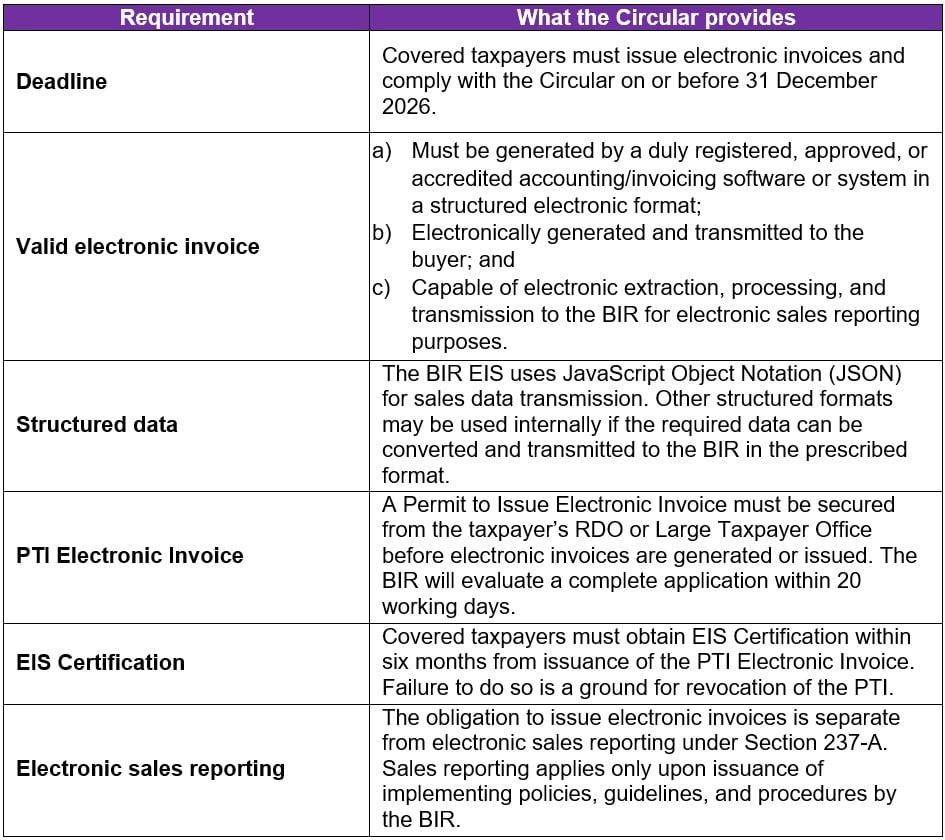
Key compliance requirements
Operational rules
Productivity applications are insufficient. Invoices manually created in Microsoft Word, Microsoft Excel, Google Docs, Google Sheets, or similar applications are not valid electronic invoices for tax compliance purposes.
Printed output alone is not enough. An invoice printed from a system is not an electronic invoice if the system cannot electronically issue and transmit the invoice to the buyer and electronically transmit or report the required sales data to the BIR.
Buyer may request a printed copy. A printed copy may be furnished for reference or record keeping, including in B2C transactions where electronic delivery is impracticable, provided the original invoice was generated and can be issued electronically and all requirements are met.
Adjustments require separate documents. A decrease must be supported by an authorized Credit Note or Memo, while an increase requires a new electronic invoice. An issued electronic invoice may not be deleted, altered, or modified.
Downtime requires manual fallback. During system or connectivity disruptions, cybersecurity incidents, force majeure, or similar events, the taxpayer must issue a BIR-authorized manual invoice. After restoration, the manual invoice must be replaced with an electronic invoice referencing the manual invoice number.
Branch compliance applies to the taxpayer as a whole. The head office and all branches must issue electronic invoices. Separate PTIs are required where distinct invoicing systems are used for different branches, offices, or business segments.
Recommended Immediate Actions of Taxpayers
- Confirm whether the taxpayer falls within the mandatory coverage and identify all affected branches and business segments.
- Assess whether the current invoicing system can generate structured invoice data, transmit invoices electronically to customers, and support conversion to the BIR-prescribed JSON format.
- Prepare for the PTI Electronic Invoice application and map any system variations across branches that may require separate permits.
- Plan EIS Certification activities so certification is completed within six months from PTI issuance.
- Establish documented downtime procedures, including use of BIR-authorized manual invoices and subsequent replacement with referenced electronic invoices.
Effectivity
The Circular takes effect immediately.
Disclaimer: This Tax Alert is a general summary of the Circular and is not a substitute for advice based on a taxpayer’s specific facts and circumstances.